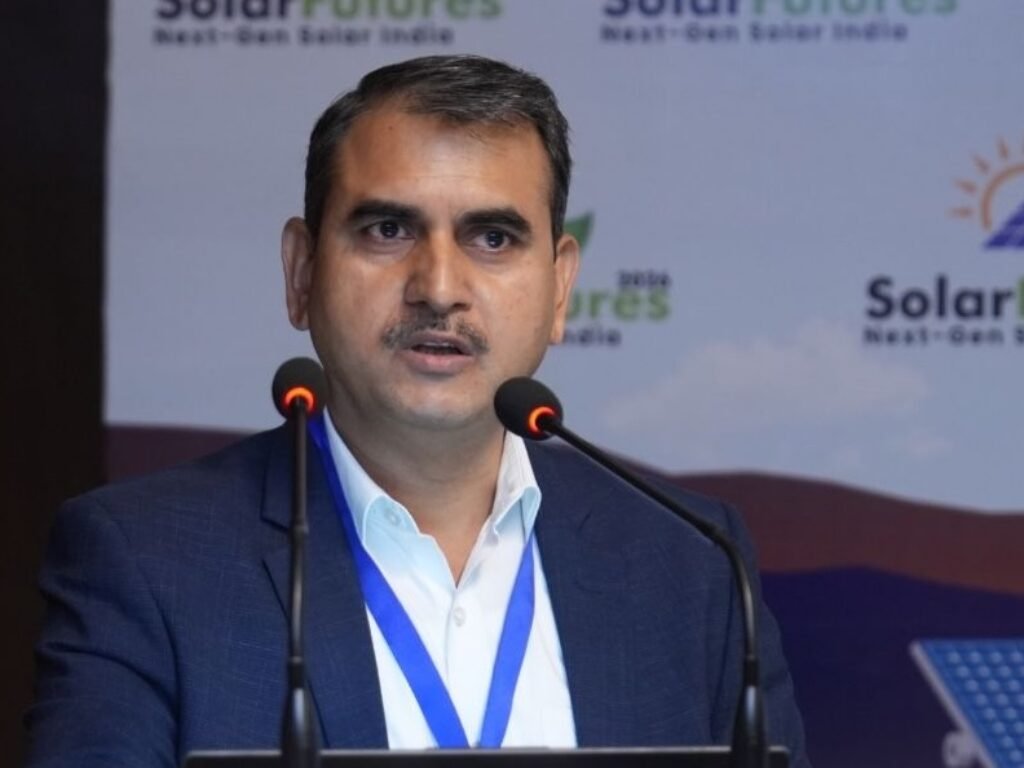
India’s expanding solar manufacturing ecosystem must now focus on building resilient supply chains, strengthening domestic manufacturing capacities and creating sustained demand through decentralised renewable energy programmes, Somnath Yogi, Head of Business Development, at First Solar India said while presenting an industry perspective on the future of solar manufacturing. Addressing a session on “Atmanirbharta in Solar PV Manufacturing” at SolarFutures 2026: Next-Gen Solar India held recently in New Delhi, he argued that policy stability and demand visibility have laid the groundwork for the industry’s next stage of expansion.
Beginning his remarks, Yogi introduced First Solar as the world’s largest thin-film solar manufacturer with a global manufacturing capacity of 25 GW. He said thin-film technology represents a form of Atmanirbharta because of its fully integrated and vertically integrated manufacturing model.
He noted that policy stability and demand clarity had emerged as critical themes, adding that the industry’s priority should now be to translate that certainty into sustainable manufacturing capacity within India.
Drawing on nearly two decades of industry experience, Yogi identified supply chain resilience as one of the most important requirements for the sector’s long-term success. He observed that India has already built more than 200 GW of crystalline manufacturing capacity and, supported by greater policy clarity, is now moving towards establishing over 30 GW of cell manufacturing capacity while expanding further upstream into wafer and silicon production. He expressed confidence that coordinated efforts by both the government and industry would accelerate this transition, describing domestic manufacturing as an inevitable direction for the sector.
Highlighting the role of demand-side programmes, Yogi pointed to initiatives such as PM Surya Ghar and PM Kusum, describing it as a uniquely effective programme because it benefits all stakeholders while avoiding some of the challenges associated with utility-scale solar projects, including land acquisition and grid connectivity constraints. Since projects are planned around existing grid infrastructure and involve decentralised generation, he said they offer shorter project cycles and create opportunities to expand capacity more efficiently over time.
Looking ahead, Yogi underscored the importance of technological innovation in manufacturing, citing fully integrated production systems, artificial intelligence-enabled manufacturing and Industry 4.0 processes as the next frontier for improving efficiency and competitiveness. He said India’s growing population and rising energy consumption would continue to support long-term demand for solar energy, adding that the industry’s focus should remain on building a more sustainable manufacturing ecosystem supported by a robust domestic supply chain.