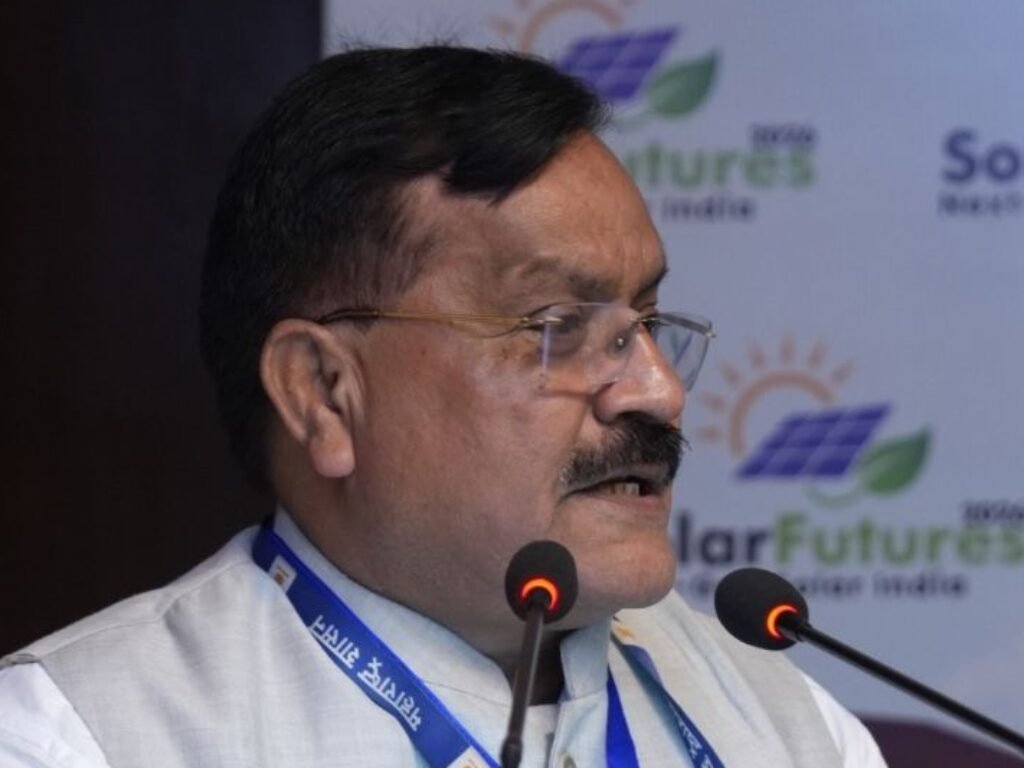
Speaking on “Solarisation: A Social Transformation” at SolarFutures 2026: Next-Gen Solar India in New Delhi, Prof Indra Mani, Vice Chancellor, Vasantrao NaikMarathwada Krishi Vidyapeeth, Parbhani, underlined the importance of solarisation as a driver of social transformation. He highlighted PM Surya Ghar, PM-KUSUM, rooftop solar and Agri-PV as key elements of this transformation, describing PM-KUSUM as a scheme that “looks soft but is very robust” and emphasising the growing importance of rooftop solar and agrivoltaics.
Mani said civilisation is facing four major challenges: food security, water security, energy security and climate change. He stressed that these are related and that energy is needed for food as well.
Turning to the importance of agriculture, Mani said that in 1950, when India had around 40 crore people, the country was starving, whereas today it has around 140 crore people and provides food free of cost to 80 crore people. He said that whenever a bad situation or problem arises in the world, India’s first response is to send food, and referred to the Prime Minister’s statement that, if need arises, India can feed the world. He described this as the strength of Indian agriculture, pointing to the increase in food grain production from 50 million tonnes to an estimated 376 million tonnes and the increase in fruits and vegetables from 20 million tonnes to nearly 400 million tonnes.
Mani said agriculture needs energy and referred to PM-KUSUM. He said there are three components and referred to the 500 kW to 2 MW range for grid and off-grid solar pumping. He also raised the question of how grid-connected solar pumps could be solarised. He said the government provides 60% subsidy and 30% loan, leaving only 10% for farmers to invest, and referred to the number of solar pumps that had already been solarised, giving a figure of about 9.2 lakh as an older figure and also referring to another figure of two lakh.
Introducing his presentation, Mani said Agri-PV is important for climate-resilient agriculture. He said Agri-PV can help address climate change, weather variations, extreme rainfall events and hailstorms, and described it as a risk-management technology in agriculture. He said agrivoltaics is gaining interest as a promising solution for ensuring food security, energy security and water security while addressing climate change.
He emphasised the water-energy-food nexus, saying these three elements should not be seen separately but jointly. According to Mani, Agri-PV addresses all three. He said rooftop solar is limited and converting agricultural land into solar land is also not possible, particularly as agricultural land is already being reduced through encroachment by buildings and cities. With 141 million hectares of agricultural land, he said mixed use therefore becomes very important and that Agri-PV is a solution because energy can be produced while agriculture continues on the same land.
Mani said that if one hectare is being used to produce wheat and energy is also produced, estimates indicate an increase of around 160%, rather than 100% or 200%, making this an efficient use of land without halting agricultural production. He also said that solar generation can be better in an Agri-PV system because the agricultural environment can help keep panels cool. Referring to panels that generate from both sides, he said agriculture can be combined with better efficiency in solar generation.
According to Mani, Agri-PV is suitable for a wide range of crops, especially shade-tolerant vegetables, spices, medicinal plants, fodder crops and selected horticultural crops. He said it offers significant potential for India, particularly in high-solar-radiation states such as Maharashtra, Rajasthan, Gujarat, Karnataka, Madhya Pradesh and Andhra Pradesh.
He stressed that successful adoption requires appropriate system design, crop selection and policy support. He said the question of land acquisition and land use was important, particularly whether land is treated as agricultural or non-agricultural. The moment its classification changes to non-agricultural use, he said, many complications arise. He also said installation cost is higher and that simple and affordable systems therefore need to be developed.
Concluding, Mani said that coming together is a beginning, keeping together is progress and working together is success. He said all different stakeholders have to come together and work together.
The conference was organised by Sustainability Karma in partnership with the National Institute of Solar Energy (NISE). The knowledge partners included the Solar Energy Corporation of India (SECI), National Solar Energy Federation of India (NSEFI), Indian Solar Manufacturers Association (ISMA), Skill Council for Green Jobs (SCGJ) and Atal Incubation Centre, IIT Delhi. The Sustainability Karma Podcast on All India Radio was the media partner.