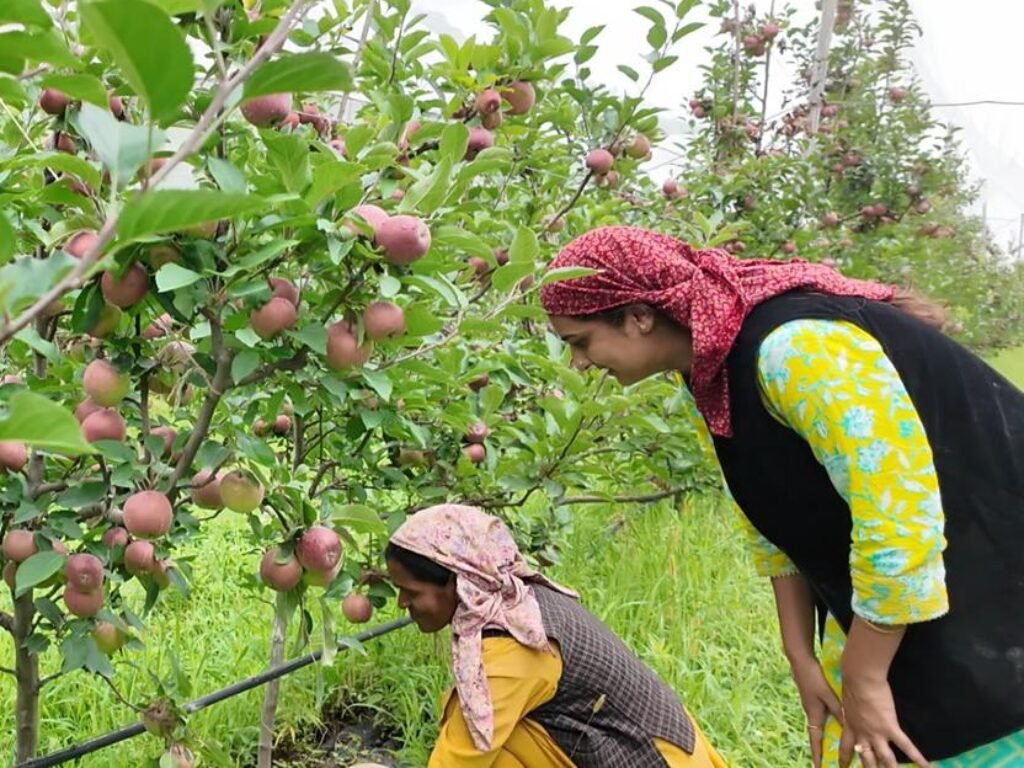
On Mahila Kisan Diwas, Tarana from Arakot, Uttarakhand, shares how shift to high-density apple farming under Project Unnati Apple has opened up new livelihood opportunities for her and women in her community. In Arakot, Uttarakhand, farming has always been closely tied to the availability of water. For Tarana, the fields once used to grow the region’s traditional red rice became difficult to cultivate when the canal that supplied them could no longer provide water. Faced with changing conditions, she chose to explore a different path. Instead of leaving the land unproductive, she turned to apple farming, planting the seeds of a new livelihood.
In 2018, Tarana established her orchard through support of Anandana- The Coca-Cola India Foundation’s Project Unnati Apple, in partnership with Indo-Dutch Horticulture Technologies. The shift introduced her to high-density apple cultivation, an alternative to traditional farming that can help growers begin harvesting much earlier. While conventional apple trees can take four to eight years to bear fruit, high-density plants can start producing within one to two years.
The decision has since brought tangible results. Today, Tarana’s orchard produces approximately 400–500 boxes of apples annually. For her, the orchard represents more than a change in crops. It is an opportunity to earn from her land and see the results of the hard work invested throughout the year. As Tarana puts it, “Now we get to enjoy the fruits of our own hard work, and we also get to eat the fruit that we receive from the trees.”
Saloni Goel, Senior Director – ESG Value Creation and Commercialisation, Coca-Cola India, said, “Women associated with the project have improved their yields and enhanced their farming skills, helping them build more resilient livelihoods. By equipping them with the knowledge to adopt improved cultivation techniques, we aim to support more effective farming practices and contribute to a more inclusive and resilient agricultural sector”.
Growing beyond the harvest
In remote areas such as Arakot, where employment and income-generating opportunities can be limited, she sees orchards as a way to create work for local communities. Maintaining the orchard requires help with activities such as grass cutting and harvesting, providing opportunities for local workers, including women.
She believes this is particularly important for women, who often have limited access to independent sources of income. “For women, this is a very good initiative. First of all, they will generate their own income,” she explains, highlighting how earning through their own work can help women become more financially independent.
The way high-density orchards are designed also makes a difference. Unlike traditional apple trees, which can grow tall and require people to climb them for pruning, these plants are shorter and easier to manage. With some technical knowledge, women can comfortably undertake pruning and participate in harvesting and other orchard activities.
For Tarana, this accessibility makes apple cultivation an option worth exploring for others with underutilised land. She also sees the potential for orchards to contribute to the wider rural economy. Beyond producing fruit, cultivated land can become more visually appealing and potentially attract visitors. With farm stays and homestays gaining interest among urban travellers seeking a rural experience, orchards could open up additional avenues for income generation.
A future shaped by her own efforts
For Tarana, every harvest is a reflection of the work that has gone into the orchard over the past year. It is also an opportunity to learn. As she looks ahead to the next season, her approach captures an important part of farming: progress comes not only from the harvest, but also from the willingness to learn, adapt and try again. What began as a response to water scarcity has given Tarana a new way to use her land, earn an income and create opportunities for other women in her community.
On Mahila Kisan Diwas, her journey highlights how access to alternative agricultural practices and technical knowledge can help women farmers build livelihoods on their own terms.
Part of the broader Project Unnati initiative, Project Unnati Apple reflects the potential of advanced horticultural practices to help farmers make productive use of their land, diversify their income and strengthen rural livelihoods. For Tarana, the promise of the orchard is simple: to see her hard work bear fruit, season after season.