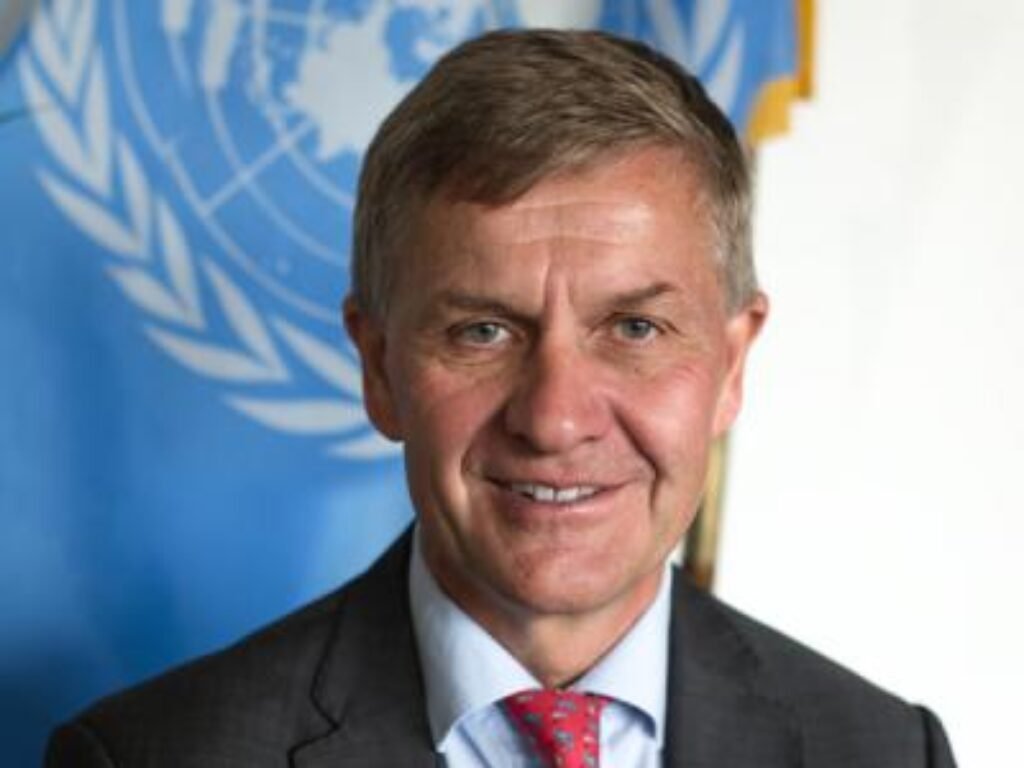
What are the main achievements of COP29 so far? What more do you expect?
There is one main achievement so far. It is the agreement or the rules for the global carbon market as to how nations can cooperate to trade carbon credits. This will provide substantial money particularly from tech companies for greening efforts in developing nations.
To take India as a case in point, I mean it can provide money for natural farming in Andhra Pradesh, for tree planting in Madhya Pradesh, for protecting the mangroves of Tamil Nadu or for overall green development of a state like Gujarat. So, it would be a huge opportunity for India emanating from the global carbon market.
How hopeful are you of achieving an agreement on the new collective quantified goal?
I tend to believe contrary to many others that this is not a big issue. Yes, we need global finance for the least developed countries, and we need money for climate adaptation, which can only be done by governments. But when it comes to making major efforts like promoting electric vehicles, and solar and industries, all these are of commercial nature and are better done through the market.
Do you think Asia is the only place where tripling of renewable power generation capacity by 2030 can be achieved or even surpassed?
For sure, Asia is the most likely place to likely to achieve or surpass the goal, but I think there is hope that other parts of the world can also achieve the goal, however, it would be a bit slower. But if we get the right policies and financial mechanisms, Africa has close to skyrocketing potential for solar. The sun is basically shining in Africa. It has a vast landmass and it is not so heavily populated like India or Indonesia. So, the potential in Africa is very big. Only impediment so far has been to get the government regulation so that investors feel they can invest.
And in Europe, the Green New Deal is also a very good mechanism to drive the green revolution. But to summarise, Asia is far ahead. Asia is the continent which is most likely to achieve this goal, but let us work with all others also so that they can follow the example of Asia.
We are living now in the age of Asia. People don’t realise it. The 19th century was the European century, dominated by European colonial powers, 20th century was the American century, and we are now approaching and already into the Asian century.
What do you think of India’s overall development trajectory?
I was very recently in Ahmedabad at a huge renewable energy conference there with Prime Minister Narendra Modi, and he spoke for one hour about green development of India. He focused on the enormous opportunities for India by going green, how India can provide jobs, prosperity, bring all Indians up into the middle class, provide energy so that every Indian can turn on the light in his/her own house, and how all industries can be powered by green energies, and also how India can shine on the international scene as one of the lead nations of the 21st century by going green.
So, for Modi, this is a state-building vision for India of green development, and that is why it will succeed. So, it is an all-out Indian effort. Look, there are no climate deniers in India. In the United States and Europe, you see a lot of people saying there is no climate change.
Not one serious political leader in India is opposing this. It is not only BJP, but even Congress, CPM, the regional parties in the South and DMK all embrace the same global green vision. So then, of course, then it is much easier to achieve it than in those nations where there are strong counter forces.