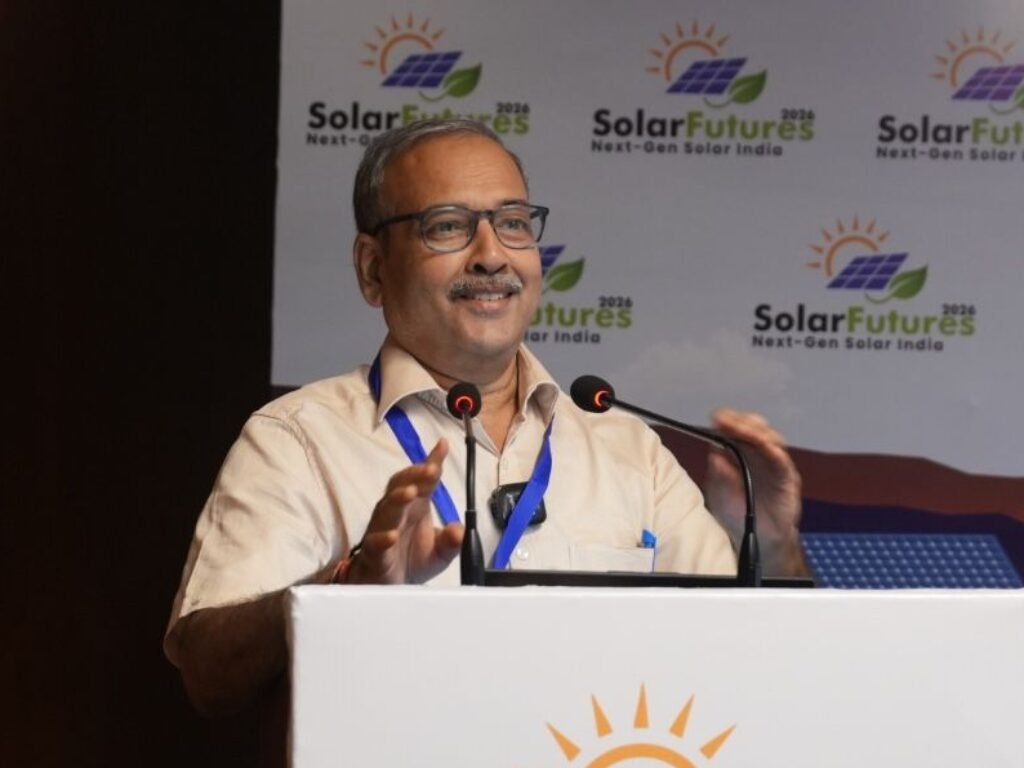
Speaking at SolarFutures 2026: Next-Gen Solar India in New Delhi, D K Singh, Former Principal Scientist & Professor and Principal Investigator, Centre of Excellence for AgriPV, ICAR-IARI, said that if rural houses were solarised under PM Surya Ghar with two or three kilowatts, or even five kilowatts, with an additional one to three kilowatts, households could use solar energy for cooking and other requirements during the day. He said a hot plate need not cost much and that the availability of solar energy could make people happy. He emphasised that solar energy has significance not only for India but for the entire globe.
He said solarisation of rural India is not needed only to meet increasing energy demand and achieve net-zero emission targets. It can provide assured power supply to rural India, enhance farmers’ incomes and boost the rural economy. He stressed that the rural economy, like any economy, is highly dependent on water and energy. Referring also to the expanding energy requirements of data centres, he noted that a medium- or small-sized data centre could require five to ten megawatts of power, while a large centre could require more than 100 MW, and referred to concerns around the grid in northern Virginia, where most of the data centres are located.
Singh then connected solar electricity and food production through agriphotovoltaics. He said the sun provides energy and that electricity generation through solar photovoltaic cells and the production of food energy through plants are based on processes involving excited electrons. In solar photovoltaic cells, excited electrons generate electrical energy, while in plants the process involving chloroplasts produces energy used for photosynthesis. He said these processes are closely linked and that agriphotovoltaics allows electrical energy and the chemical energy of food to be produced from the same piece of farmland.
He said India is very favourable for agriphotovoltaics, pointing to 141 million hectares of cultivable land. Agriculture, he said, consumes almost 17% of electricity and contributes around 13% of greenhouse-gas emissions, making a case for bringing solar panels onto agricultural land.
Singh highlighted multiple and additional income and employment generation as advantages. Referring to data published by the Ministry of New and Renewable Energy, he said PM-KUSUM was expected to reach 32 GW in a few years and, according to the figure he cited, create 17 million jobs. He said the employment associated with the already reached 157 GW of solar capacity had not yet been calculated or given prominence. He added that solar is green energy and would help reduce carbon emissions.
On the relationship between water, energy and farming, Singh said that where groundwater irrigation is used and there is no grid connection, diesel becomes an alternative source of energy, with implications for the cost of diesel and greenhouse-gas emissions. Solar energy, he said, can enable multiple activities: intensify agriculture, increase cropping intensity and increase farmers’ income.
He gave examples of how solar power could increase farm income through processing and value addition. A rice farmer with a small 10, 15 or 20 kW solar system could mill the rice instead of selling paddy, using solar energy to run a small rice mill and sell rice at almost double the price of paddy. In the Sagar example, he said a tomato producer could process and add value to tomatoes using solar energy and sell surplus energy to the grid. He also referred to chilli cultivation, saying an agrivoltaic-type arrangement could help chilli farmers with processing, packaging and storage, and mentioned similar possibilities for peanuts.
Singh said agriphotovoltaics is not, however, simple and that there are many challenges. His first point was that agriphotovoltaics is not a defined activity in government documents, gazettes or MNRE documents. Benefits associated with solar panels or agriculture come under different heads: benefits for farmers come in the name of agriculture, while bank loans or credit come in the name of solar rather than agriculture. He said this needs to be defined. He also pointed to land availability and the trade-off involving reductions in the yield of major crops when solar panels are installed on agricultural land.
He said not every crop would benefit from agriphotovoltaics. Vegetable and leafy-vegetable crops and photo-insensitive crops could do well, with some having characteristics similar to indoor plants, but agriphotovoltaics would not be suitable for all crops. He also identified tariffs as another driver that could either press or suppress expansion in different states, and referred to safety, cleaning, aspiration and land-use policy as other issues.
On land conversion, Singh said agricultural land cannot simply be converted into another land use. Referring to a discussion he had the previous day, he proposed that the primary land use should remain agriculture, with energy treated as something like a by-product from the same land. He said no farmer would allow agricultural land to be converted even if it were leased for 25 years. Whatever benefits are to be given for agriphotovoltaic activity, he said, a method, device or policy needs to be designed around agriculture remaining the primary land use.
Summarising the policy issues, Singh referred to land-use questions and curtailment. He said Rajasthan was facing a major curtailment problem and that Gujarat could face the same issue, with states going beyond 15 GW or 20 GW likely to face curtailment. He also said PM Surya Ghar was having an impact on DISCOMs, noting that DISCOMs were not able to sell power in some areas because PM Surya Ghar had saturated the city and people in many towns of Gujarat were getting electricity almost free of cost. He said these issues needed to be dealt with at the government level, with stakeholders taken into confidence. He also mentioned feeding tariffs, land leasing and tax on income.
Singh said taxation and income questions would become more important as agriphotovoltaics expanded. If solar panels were installed across 10,000, 20,000, 50,000 or 100,000 hectares, he asked how income from agriculture and solar would be treated when a farmer installed the PV system on his own land, and how income from energy sales and agriculture would be treated when a developer installed a PV system on a farmer’s land. He said these were not big issues now but would become big issues in the next two, three or four years.
Looking ahead, Singh said agriphotovoltaics should become a component of PM-KUSUM and expressed the hope that there were indications that this would happen. He said agrivoltaics would be recognised as an activity. Referring to the expansion of PM-KUSUM, he noted the figures of 9 GW and 12 GW and the 32 GW target, and then made a calculation for rural households. India has about 30 crore households, he said, of which about 19 crore are in rural India. At five units per household, he calculated a potential of about 200 GW in rural India.
Singh also advocated distributed renewable energy, saying it has huge potential and could bring down the load on the national grid. He argued that even if additional or modernised grid infrastructure were created, it could take 10 to 20 years, and the country could not wait that long for evacuation infrastructure and generating power plants. He said distributed renewable energy, integrated with battery storage, could make a major difference and could also be linked with CNG or green-hydrogen production from solar energy and with charging scooters, motorcycles and electric bikes.
He said agriphotovoltaics was particularly important for rural infrastructure. Rural areas have primary health centres, schools, panchayats, fisheries and other facilities, as well as storage machinery and repair centres. He questioned why rural India should be deprived of supermarkets, air-conditioned malls and similar facilities when solar energy is available. If solar energy is free, he said, such facilities could be created and air-conditioning could be run using solar energy. He said this should be the vision for the future, with these units coming up in rural areas to reduce pressure on urban areas and cities and make villages modern.
Singh also linked solar energy with agro-processing. He questioned why, despite a huge allocation under the Agriculture Infrastructure Fund, including thousands of crores, agro-processing industries had not come up in rural areas on the expected scale. He said the reason was the absence of energy. If energy had been available, the Agriculture Infrastructure Fund could have been utilised effectively for infrastructure and value-addition units in rural areas. He said this should be part of the plan or vision for the future.
The conference was organised by Sustainability Karma in partnership with the National Institute of Solar Energy (NISE). The knowledge partners included the Solar Energy Corporation of India (SECI), National Solar Energy Federation of India (NSEFI), Indian Solar Manufacturers Association (ISMA), Skill Council for Green Jobs (SCGJ) and Atal Incubation Centre, IIT Delhi.
The Sustainability Karma Podcast on All India Radio was the media partner.