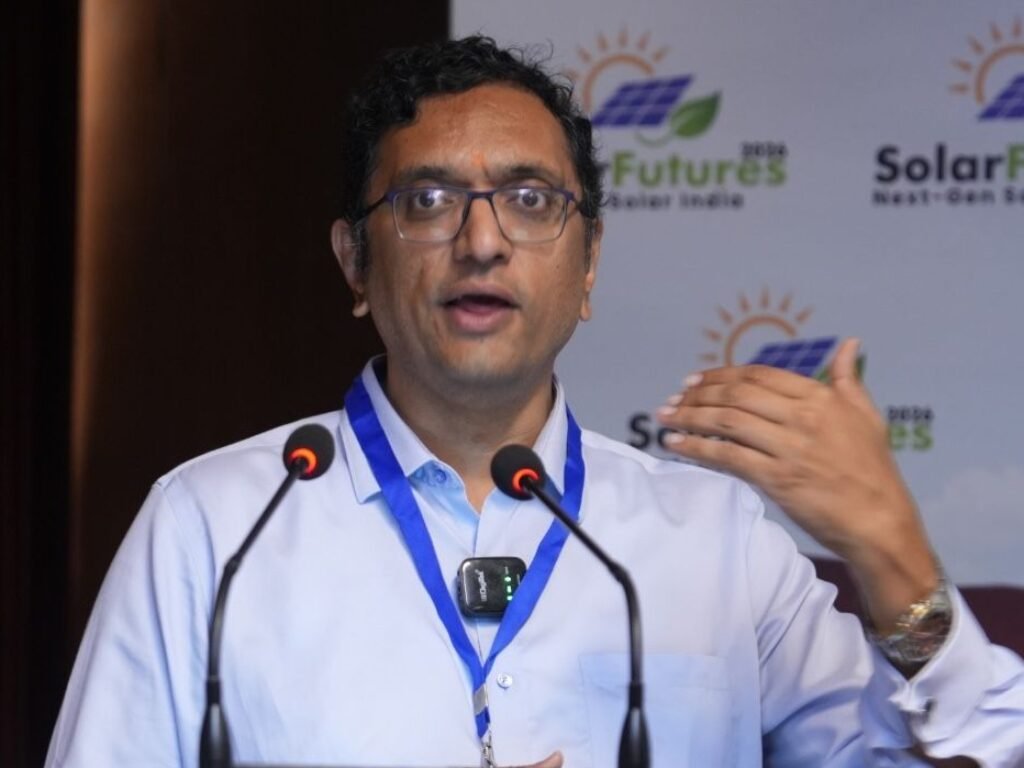
India’s transformation into one of the world’s leading solar manufacturing hubs has been underpinned by policy certainty, entrepreneurial ambition and the increasing affordability of solar energy, Anshul Khandelwal said while outlining the next phase of the country’s manufacturing journey. Speaking during a session at SolarFutures 2026: Next-Gen Solar India held recently in New Delhi, he argued that the sector must now focus on creating stronger domestic demand while leveraging the country’s manufacturing capabilities to emerge as a global export hub.
India’s transformation into one of the world’s leading solar manufacturing hubs has been underpinned by policy certainty, entrepreneurial ambition and the increasing affordability of solar energy, Anshul Khandelwal said while outlining the next phase of the country’s manufacturing journey. Speaking during a session at SolarFutures 2026: Next-Gen Solar India held recently in New Delhi, he argued that the sector must now focus on creating stronger domestic demand while leveraging the country’s manufacturing capabilities to emerge as a global export hub.
Reflecting on the industry’s evolution over the past decade in the session themed “Atmanirbharta in Solar PV Manufacturing.” Khandelwal said India’s manufacturing ecosystem has expanded across the entire solar value chain, including modules, cells, ingot wafers, polysilicon and a broad range of ancillary industries. He attributed this transformation to three key factors: demand certainty created through government policies, the willingness of Indian entrepreneurs to invest and take risks, and the affordability of solar technology, which together have generated sustained market demand.
Looking ahead, Khandelwal said the industry has now reached a stage where the manufacturing base has been established and the emphasis should shift towards strengthening the demand pull. He said India’s drive towards Atmanirbhar solar manufacturing should be leveraged to achieve two objectives—accelerating exponential growth in the domestic market and positioning the country as a competitive export hub for solar manufacturing.