For more than a decade, India’s solar story has been defined by record-breaking capacity additions and ambitious renewable energy targets. Today, however, the conversation is shifting. The central question is no longer whether India can deploy solar power at scale, but whether it can build an internationally competitive manufacturing ecosystem capable of serving both domestic and global markets.
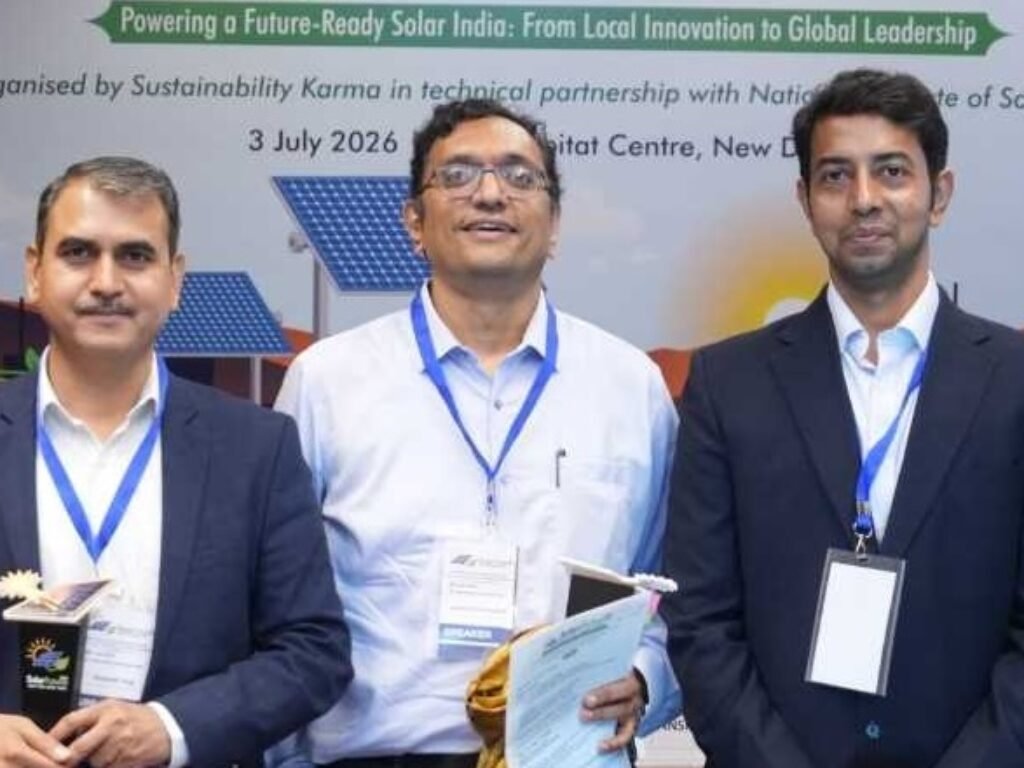
That broader transition formed the focus of the session “Atmanirbharta in Solar PV Manufacturing” at SolarFutures 2026: Next-Gen Solar India, organised by Sustainability Karma in partnership with the National Institute of Solar Energy (NISE) recently in New Delhi. Bringing together industry leaders representing manufacturing, technology and policy, the discussion explored how India can strengthen domestic production across the solar value chain while remaining integrated with global supply chains.
Setting the context, Anshul Khandelwal, CEO of RPSG Solvanta, reflected on the remarkable transformation of India’s manufacturing landscape over the past decade. He noted that India has developed capabilities across modules, cells, ingot wafers, polysilicon and ancillary industries—a journey he attributed to three defining factors: policy certainty created by government initiatives, the willingness of Indian entrepreneurs to invest and take risks, and the steadily improving affordability of solar technology.
According to Khandelwal, these factors have created the demand pull that enabled manufacturing investments to flourish. However, he argued that the industry’s priorities must now evolve. Having established the foundations of domestic manufacturing, India should focus on expanding demand further, accelerating domestic deployment and positioning itself as a global export hub. He suggested that the country’s drive towards Atmanirbhar solar manufacturing should now support both exponential domestic growth and international competitiveness.
While the downstream manufacturing ecosystem has matured rapidly, Amit Manohar, Secretary General of the Indian Solar Manufacturers Association (ISMA), argued that India’s next challenge lies further upstream. He pointed out that although India has built around 200 GW of module manufacturing capacity and 30.8 GW of cell manufacturing capacity, wafer and ingot production remains limited to around 3.3 GW, while domestic polysilicon manufacturing is still absent.
This imbalance, he explained, continues to leave Indian manufacturers dependent on imported upstream materials despite the country’s growing self-reliance in modules and cells.
Manohar described the government’s phased Approved List of Models and Manufacturers (ALMM) framework as a roadmap for addressing this gap. Beginning with domestically manufactured modules, then extending to Indian-made cells through ALMM List-II, the policy is expected to move further upstream with ALMM List-III, which will require wafers and ingots manufactured in India once sufficient domestic capacity has been established.
Supported by the Production Linked Incentive (PLI) Scheme, Basic Customs Duty (BCD) and Domestic Content Requirement (DCR) provisions in government procurement, these measures, he said, provide manufacturers with the long-term demand certainty necessary to justify large-scale investments.
According to Manohar, India could attract Rs 25,000-30,000 crore of investment into wafer and ingot manufacturing over the next two to three years, potentially expanding domestic capacity to nearly 50 GW by 2028. Even if only half of the announced projects materialise, he suggested, India would still be capable of meeting domestic demand.
However, significant challenges remain. Manufacturing equipment continues to be sourced largely from China, while wafer production requires uninterrupted electricity, substantial water resources and significantly larger industrial infrastructure than module assembly. Competitive electricity pricing, he argued, will become increasingly important because power accounts for roughly one-quarter of wafer production costs.
Beyond investment and policy, the discussion also highlighted the importance of technological diversification and resilient supply chains.
Representing First Solar India, Somnath Yogi said India’s manufacturing ambitions should not be viewed only through the lens of crystalline silicon technology. Introducing First Solar’s thin-film manufacturing model, he described vertically integrated production as another pathway towards Atmanirbharta, demonstrating how alternative technologies can strengthen domestic capabilities while reducing supply chain vulnerabilities.
Yogi argued that policy stability and demand visibility have already created the confidence required for manufacturers to invest, but future growth will increasingly depend on building resilient supply chains and expanding decentralised demand.
He identified programmes such as PM Surya Ghar and PM Kusum as particularly significant because they combine domestic manufacturing with decentralised solar deployment. Unlike large utility-scale projects that often face land acquisition and grid connectivity challenges, decentralised programmes create distributed demand, shorten project cycles and enable faster deployment while supporting local manufacturing.
Looking ahead, Yogi also pointed to artificial intelligence-enabled manufacturing, Industry 4.0 technologies and fully integrated production systems as the next frontier for improving manufacturing efficiency and competitiveness. As India’s energy consumption continues to grow alongside changing patterns of electricity demand, he said sustained domestic demand would remain one of the strongest foundations for manufacturing expansion.
Taken together, the discussion reflected an important evolution in India’s solar ambitions. If the first phase focused on becoming one of the world’s largest solar markets, the next phase is about mastering the technologies, supply chains and industrial capabilities that underpin global leadership.
For industry leaders at SolarFutures 2026, achieving true Atmanirbharta will require far more than expanding factory capacity—it will depend on aligning policy, investment, innovation and domestic demand to build a resilient manufacturing ecosystem capable of competing on the world stage.