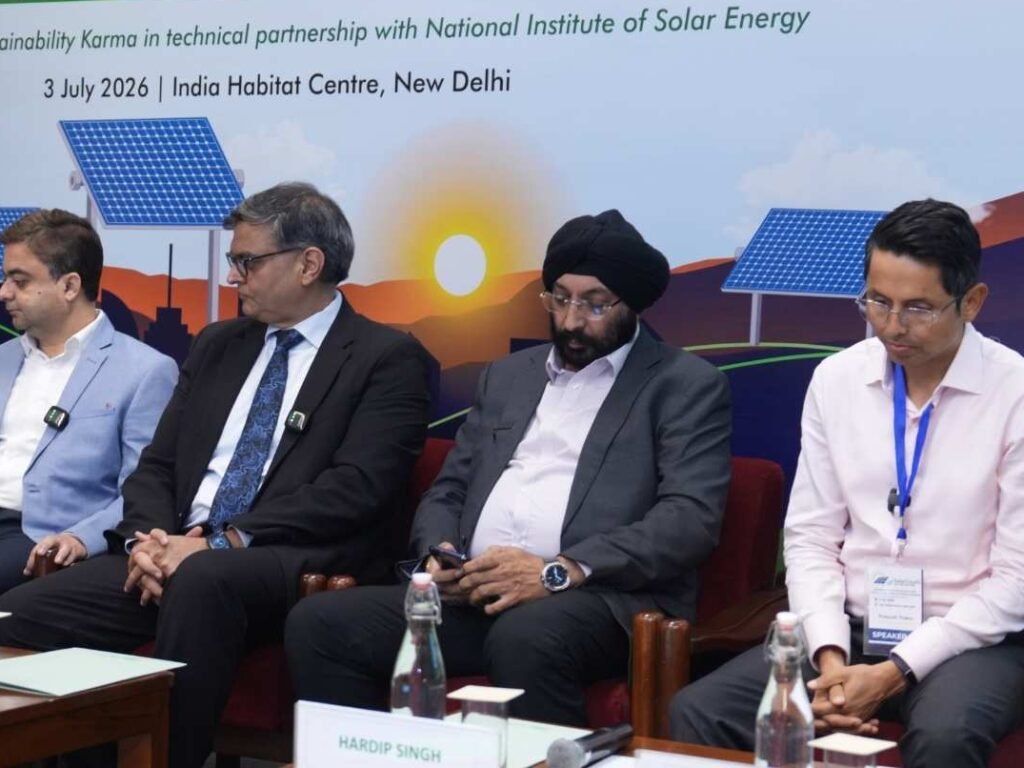
India’s next solar leap will be measured not just in gigawatts installed but in the strength of its manufacturing base, the intelligence of its electricity grids and the participation of its consumers. Setting the tone at the inaugural session of SolarFutures 2026: Next-Gen Solar India, representatives from government, industry and research institutions presented a shared vision for building a resilient, innovation-led solar ecosystem capable of taking India from local innovation to global leadership.
Organised by Sustainability Karma in technical partnership with the National Institute of Solar Energy (NISE), the conference was held under the theme, “Powering a Future-Ready Solar India: From Local Innovation to Global Leadership.”
Delivering the inaugural address via All India Radio, Shripad Yesso Naik, Union Minister of State for Power and New & Renewable Energy, outlined a vision of a consumer-centric energy ecosystem where electricity users increasingly become energy producers. He stressed that decentralised solar, smart energy systems and collaborative action are essential to achieving India’s aspiration of becoming the renewable energy capital of the world.
Building on that vision, Dr Mohammad Rihan, Director General of NISE, highlighted the operational challenges accompanying rapid renewable energy expansion. Calling climate change an urgent global concern, he presented a long-term roadmap centred on flexible electricity grids, demand-side management, smart inverters, improved forecasting and stronger transmission infrastructure to sustain India’s clean energy transition.
Providing a global perspective, Ashish Khanna, Director General of the International Solar Alliance, argued that energy crises should serve as opportunities to accelerate solar deployment rather than delay it. He emphasised that the future of solar lies not only in expanding installed capacity but also in integrating renewable energy efficiently through decentralised systems, innovation and sustained investment.
The discussion then shifted to manufacturing, where Hardeep Singh, Chief Operating Officer of GREW Solar, underlined the importance of strengthening India’s solar photovoltaic manufacturing ecosystem. He said stable long-term policy support, globally competitive manufacturing standards, world-class production facilities and the development of a robust semiconductor ecosystem would be critical to building a resilient and internationally competitive clean energy industry.
Addressing the role of electricity distribution, Abhishek Ranjan, CEO of BSES Rajdhani Power, said India’s next phase of solar growth will depend on stronger distribution infrastructure and demand-driven grid planning. He stressed the need to improve grid reliability, optimise electricity demand and support rooftop solar and battery integration to ensure renewable energy is effectively absorbed into the power system.
Expanding the conversation to market design, Pratyush Thakur, Country Head (India) of Blueleaf, argued that the solar sector must now move beyond capacity expansion towards more flexible electricity markets. He highlighted the importance of grid readiness, hybrid renewable projects, battery storage, merchant power markets and diversified commercial models in supporting the next stage of clean energy growth.
Concluding the inaugural session of the conference Prof (Dr) K G Suresh, Director of India Habitat Centre, reminded participants that technology alone cannot drive the energy transition. He emphasised that communication, public awareness and cross-disciplinary collaboration are equally important in ensuring that clean energy solutions are accessible, available and affordable, transforming renewable energy into a broad-based public movement.
Together, the speakers presented complementary perspectives on the evolution of India’s solar sector—from policy and infrastructure to manufacturing, markets and public engagement. Collectively, their messages reinforced the conference theme, Powering a Future-Ready Solar India: From Local Innovation to Global Leadership, highlighting that India’s clean energy future will depend on coordinated action across the entire solar value chain.