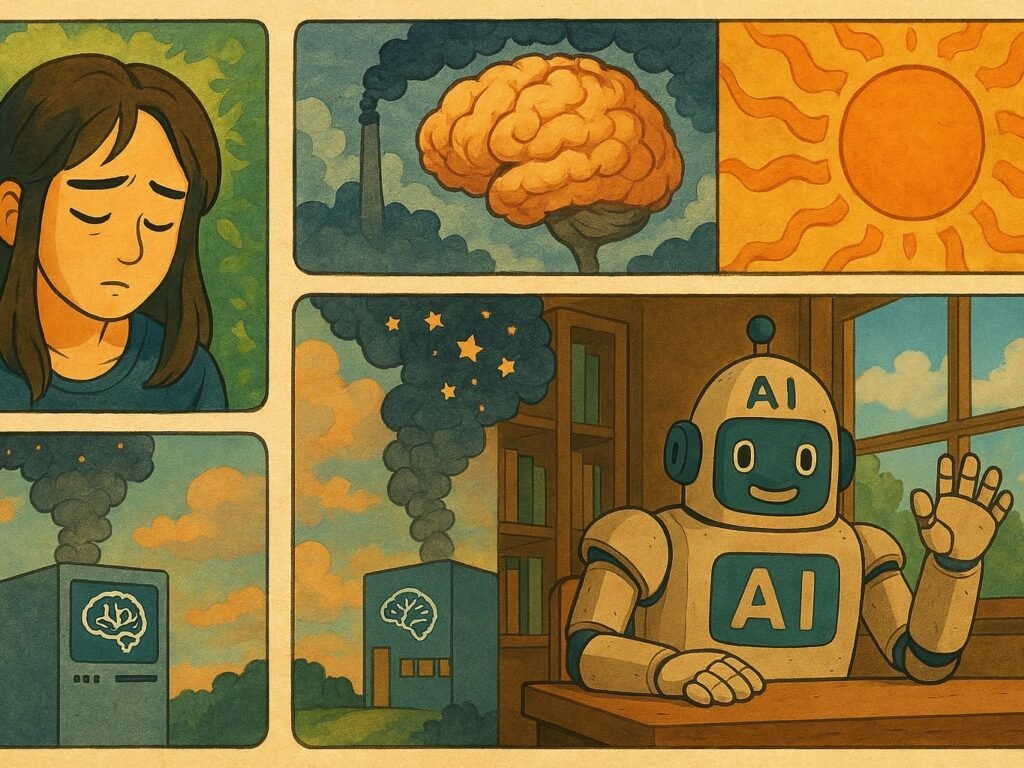
The Studio Ghibli frenzy has taken over the internet, with everyone looking like a Ghibli-style digital clone of their friends and family. The load of this frenzy on the graphic processing units (GPUs) in OpenAI’s server farms is so enormous that Sam Altman, the company CEO, wrote on X, “can yall please chill on generating images this is insane our team needs sleep we just haven’t been able to catch up since launch so people are still working to keep the service up biblical demand, i have never seen anything like it.”
In another tweet, he wrote, “it’s super fun seeing people love images in chatgpt. but our GPUs are melting.”
As is obvious from Altman’s laments, Gens X, Y and Z, baby boomers and even Gen Alpha are generating these images with a dopamine and adrenaline concoction. However, this concoction comes at a cost that impacts the planet. The degrees of harmful impact of generating AI images on the environment are complicated and varied. For example, a sustained burst in the demand for such images impacts the demand for critical minerals, rare earth elements and water resources. With time, it can lead to compounded impact on biodiversity, food and water security and pollution, according to a report by the United Nations Environment Programme Navigating New Horizons 2024.
As technology breaks new frontiers, becomes more innovative and competes with human intelligence, the environmental concerns keep accumulating. Prateek Raj, an associate professor at University College London and affiliate fellow at the Stigler Center at the University of Chicago, says, “Big Tech has a long history of following the idea of ‘move fast and break things’, due to which they introduce technologies first and think about their consequences later. The intentions with which these technologies get introduced are also often not meant to improve people’s lives, but rather to keep people ‘hooked’ to their apps and services, as innovations often focus on visceral and viral content. Unfortunately, this leads to sustainable and responsible innovation taking a back seat.” He adds that despite the massive adoption of social media, it is debatable if it has managed to improve people’s lives as much as it had the potential to do so.
Data centres require water both for cooling and powering servers, especially the ones that have high-end GPUs for processing images and moving content. One Google search, for instance, needs half a millilitre of water in energy, whereas ChatGPT needs 500 millilitres of water for running every five to 50 prompts, according to a science policy brief, titled AI’s Excessive Water Consumption Threatens To Drown Out Its Environmental Contributions submitted to United Nations STI Forum 2024. It adds that energy consumption in data centres in the course of training large-language models can double by 2026. Data centres are likely to require water withdrawals of 4.2 to 6.6 billion cubic metres by 2027.
The United Nations Conference on Trade and Development (UNCTAD) agrees with the findings of this paper in its The Digital Economy Report 2024. The UN body states that Meta’s demand for computing for machine-learning training and application has seen a greater than 100 per cent increase annually, and Microsoft, in training of GPT-3, the model on which the initial versions of ChatGPT are based, “in its data centers in the United States has been estimated to have directly consumed 700,000 litres of potable water for cooling”.
At the same time, global data centres have become energy guzzlers, whose appetite will increase exponentially in the coming years. Nalin Agarwal, founding partner at the start-up enabler firm Climate Collective, says, “AI data centres’ energy consumption is set to surge, with projections indicating a 160% increase by 2030 due to the growing demands of generative AI. This will lead to a growth in electricity demand not seen in a generation. Data centres today consume about 2% of global power, a figure expected to double to 4% by 2030, which will be largely driven by GenAI.”
However, the environmental concerns of a connected world highly dependent on global data networks do not centre around just data centres. The user end of the network makes its own strenuous demands on resources as the world moves towards faster connection speeds with deeper penetration. The UNCTAD report notes that higher connection speeds lead to more generation of data, which is then collected, stored and analysed, on which technologies like big data analytics, artificial intelligence and the internet of things are founded. The report states that the number of internet-connected objected is projected to increase from 13 billion in 2022 to 35 billion in 2028. Presently, it says, the linear digital economy production model is“based on take/extract–make–use–waste. This leads to more demand for raw materials, water and energy, greater emissions of GHGs and more waste at the end-of-life phase”.
Agarwal argues that global tech giants are mindful of the environmental impact of GenAI and are, therefore, exploring ways to mitigate it. He says, “Energy use and emissions from AI data and compute centres will only accelerate in future, and the Studio Ghibli trend may just be a drop in the ocean. Yet, it underscores the urgency of transitioning to clean energy, and why tech giants like Google, Microsoft and Amazon are securing long-term nuclear and renewable energy deals—including on small modular reactors and large-scale renewable energy—to meet this massive demand sustainably.”
Google publishes the Google Environment Report to show accountability towards climate issues caused by its business practices. In the 2024 version of the report, it states that in 2023, its total data centre electricity usage went up by 17 per cent, even after providing a 100 per cent global renewable energy match. It claims that in 2023, the company kept servers as long as possible by refurbishing, reusing or reselling components.“In 2023, we achieved 64% carbon-free energy on average across all of our data centers, and we purchased over 25 TWh of renewable electricity-including from PPAs, on-site renewable energy generation, and grid renewable energy,” the report states.
In the report, Google quotes the climate economist Nicholas Stern Chair from the Grantham Research Institute on Climate Change and the Environment, London School of Economics, as saying, “The world has in its hands the potential to apply artificial intelligence (Al) and machine learning (ML) to drive forward the net-zero transition and give us a chance to stay within 1.5°C. Al and ML can contribute massively to the pace of processes, can drive higher productivity, and can help design and run better systems. Together, they can unlock new growth that is sustainable, resilient, and equitable-whilst managing the immense and urgent risks of climate change, biodiversity loss, and pollution.”
Prateek Raj is also a votary of the equitable use of technology, but he feels that the current focus of Big Tech may not contribute to this cause. He wants companies bringing AI innovations to be pushed towards responsible and sustainable use of AI. However, he argues, “I wait for the day when AI technology can actually help the poor with their medical queries and help children from low-income households get education. That is the useful, responsible and inclusive use of AI technology”. He says, “We need to nudge AI technology in the right direction, so that resources are used judiciously and sustainably to create real change in people’s lives, and not for viral and stolen moments of marketing.”
In the era of instant gratification, we tend to ignore the future of the planet. Creating Studio Ghibli-style imagery satiates our artistic impulse, but, as Altman says, it is “melting” resources. Hayao Miyazaki, co-founder of the original Japanese organisation Studio Ghibli, states in a different context that AI-generated animation is an “insult to life itself”. In the Studio Ghibli moment of GenAI, it could be an insult which is neither locatable in the movements of climate justice nor, as Raj put it, in social justice.