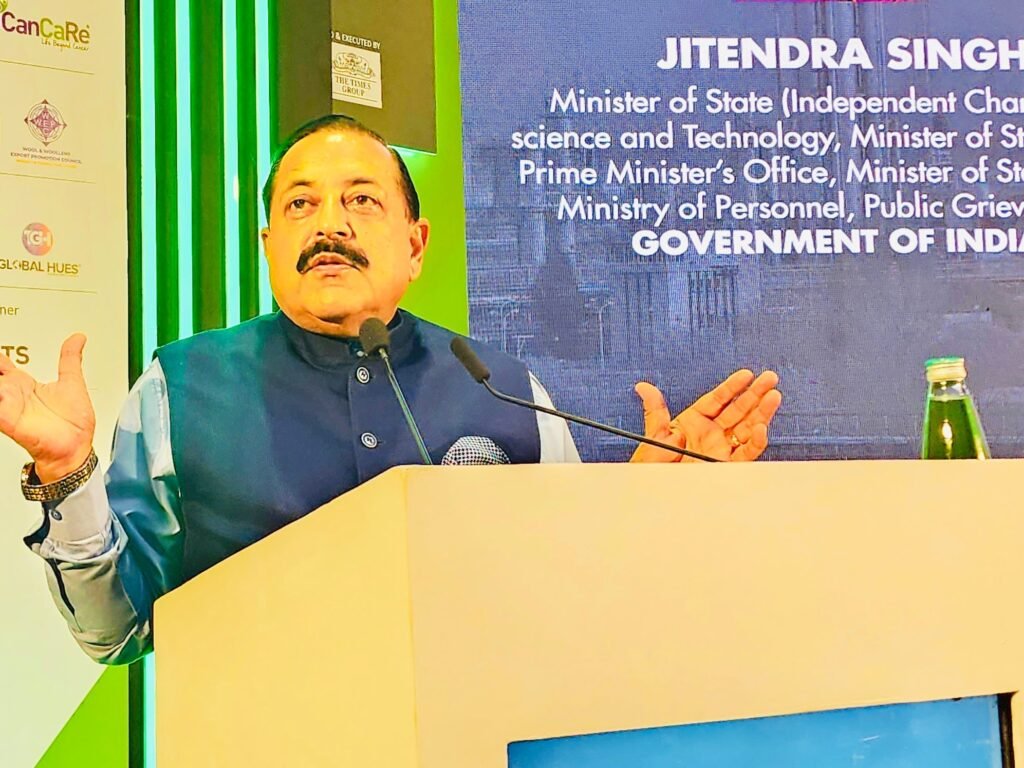
India has reaffirmed its commitment to achieving net zero greenhouse gas emissions by 2070, according to Union Minister of State (Independent Charge) for Science & Technology, Dr. Jitendra Singh. Speaking at the ‘Green Ribbon Champions’ programme in New Delhi, Dr. Singh emphasised India’s dedication to international climate goals, clean energy innovation, and sustainable development.
Dr. Singh noted that India is committed to contributing to the United Nations Sustainable Development Goals (SDGs) through research, innovation, and global partnerships. He highlighted India’s ambitious targets under the Panchamrit action plan, which include achieving 500 GW of non-fossil fuel energy capacity by 2030, meeting at least half of the country’s energy demand via renewable sources, reducing CO2 emissions by one billion tons, and lowering carbon intensity below 45 percent. These targets are key steps towards India’s ultimate goal of net zero emissions by 2070.
He recalled that Prime Minister Narendra Modi, at the 26th session of the UNFCCC COP26 in Glasgow, presented India’s five “nectar elements” of climate action and introduced the global ‘Lifestyle for Environment’ (LiFE) mission, aimed at encouraging sustainable lifestyles internationally.
Dr. Singh highlighted India’s leading role in global clean energy initiatives, noting that the country is a founding member of Mission Innovation, a global initiative launched at COP21 in 2015 to accelerate the clean energy revolution. India led innovation challenges in Smart Grids, Off-Grid Electricity Access, and Sustainable Biofuels and continues to promote clean energy through public-private partnerships under Mission Innovation 2.0.
Significant programmes under India’s clean energy agenda include the Clean Energy Ministerial (CEM) campaigns, such as the Global Lighting Challenge, UJALA (Unnat Jyoti by Affordable LEDs for All), and the ‘One Sun-One World-One Grid’ initiative to harness solar energy. Dr.Singh also highlighted India’s role in the Global Biofuels Alliance (GBA), established with Brazil, the United States, and other countries, to promote global collaboration in biofuel adoption.
India is implementing the world’s largest renewable energy expansion, targeting a five-fold increase in renewable capacity. Dr Singh noted the country’s progress in solar, hydropower, and hydrogen energy, including the National Hydrogen Energy Mission and projects such as Hydrogen Valleys, 2G ethanol pilots, and advanced biofuels development. These initiatives are complemented by India’s Cooling Action Plan and Bio-based Economy roadmap, expected to reach $150 billion by 2025.
Nuclear energy also forms a critical part of India’s clean energy strategy, with the Department of Atomic Energy targeting 20 GW nuclear capacity by 2030, which would position India among the top global producers.
Dr. Singh further emphasised India’s efforts in marine research, sustainable fisheries, and tackling oceanic plastic pollution. He mentioned that the National Research Foundation (NRF) Bill, 2023, would boost research and innovation with an estimated investment of Rs. 50,000 crores over five years, strengthening clean energy R&D and supporting India’s climate commitments.
He also noted that despite global mitigation efforts, the Earth’s average temperature could rise by 2.1°C by 2100, highlighting the urgency of India’s climate actions. Dr. Singh pointed out that India’s energy-mix strategies—including a shift towards clean energy alternatives, enhanced manufacturing capacities, energy efficiency measures, and hydrogen incentives demonstrate the country’s leadership in climate action.
According to Dr. Singh, India has achieved the fastest renewable capacity addition among major economies, with renewable energy already accounting for 40% of its electricity generation, surpassing the Paris Agreement’s 2030 target. With its comprehensive approach encompassing renewable energy, hydrogen, biofuels, nuclear power, and sustainable technologies, India is positioned to lead global efforts towards a net zero future.