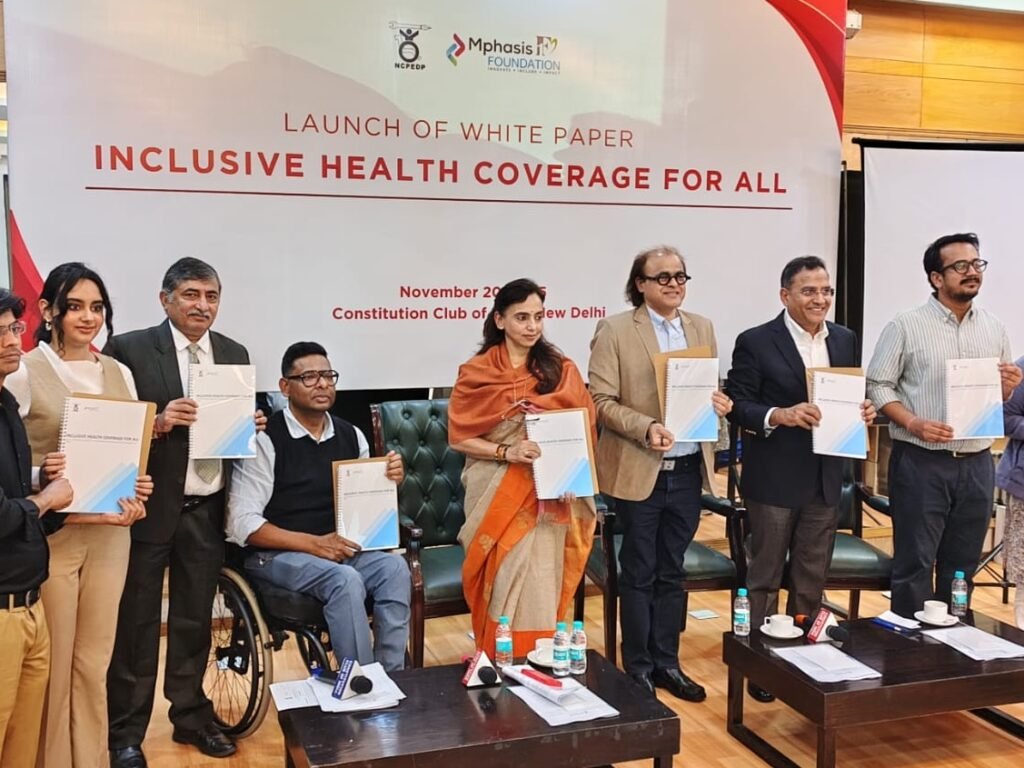
A new report exposes the deep systemic inequities that continue to deny equitable access to health insurance, both public and private, to approximately 16 crore Indians with disabilities.
The white paper titled “Inclusive Health Coverage for All: Disability, Discrimination and Health Insurance in India”, was released by the National Centre for Promotion of Employment for Disabled People (NCPEDP) at a national roundtable bringing together policymakers, industry leaders, and media representatives.
Drawing on a nationwide survey, conducted between 2023 and 2025, of over 5,000 persons with disabilities across 34 states and UTs, along with case studies, policy reviews, and stakeholder consultations, the white paper reveals a stark reality: 80% of persons with disabilities have no health insurance, and 53% of those who apply face rejection, often without any explanation.
Despite constitutional guarantees, directives issued by the Insurance Regulatory and Development Authority of India (IRDAI), and the mandates of the Rights of Persons with Disabilities Act (2016), the report finds that persons with disabilities continue to encounter discriminatory underwriting practices, unaffordable premiums, inaccessible digital insurance platforms, and a widespread lack of awareness of available schemes.
Many applicants are refused insurance solely based on their disability or pre-existing conditions, with particularly high rejection rates among persons with autism, psychosocial disabilities, intellectual disabilities and blood disorders like thalassemia.
“This whitepaper comes at a crucial moment. Even as the government expands Ayushman Bharat (PM-JAY) to cover all senior citizens aged 70 and above, persons with disabilities remain conspicuously excluded despite facing equal, if not greater, health vulnerabilities. There is no principled or policy justification for this gap. The continued exclusion of persons with disabilities from affordable and comprehensive health insurance is more than a systemic failure. It is a violation of rights,” said Arman Ali, Executive Director, NCPEDP.
He added that as India advances toward universal health coverage, extending equitable protection to the country’s 16 crore people with disabilities and their families is not optional. It is a moral imperative, a constitutional responsibility and essential for a truly inclusive healthcare system. India cannot be burdened with the generational ‘cost of exclusion’ of people with disabilities”.
To address these systemic gaps, the white paper outlines several key recommendations. It calls for the immediate inclusion of all persons with disabilities under Ayushman Bharat (PM-JAY), without any age or income criteria, in alignment with the 2024 order that extends coverage to senior citizens aged 70 and above.
The proposal further demands enhanced coverage for mental health, rehabilitation, and assistive technologies, along with the creation of a dedicated Disability Inclusion Committee within IRDAI. It also stresses the need to raise awareness among insurers and healthcare staff to ensure disability-sensitive service delivery. Additionally, it recommends the introduction of standardised premiums for disability-inclusive policies across all private insurance companies, while ensuring accessible mandatory processes and mechanisms for people with disabilities.
NCPEDP also urges policymakers, regulators and the media to drive a national dialogue on disability-inclusive health insurance, shifting the narrative from charity-based approaches to rights-based healthcare access.