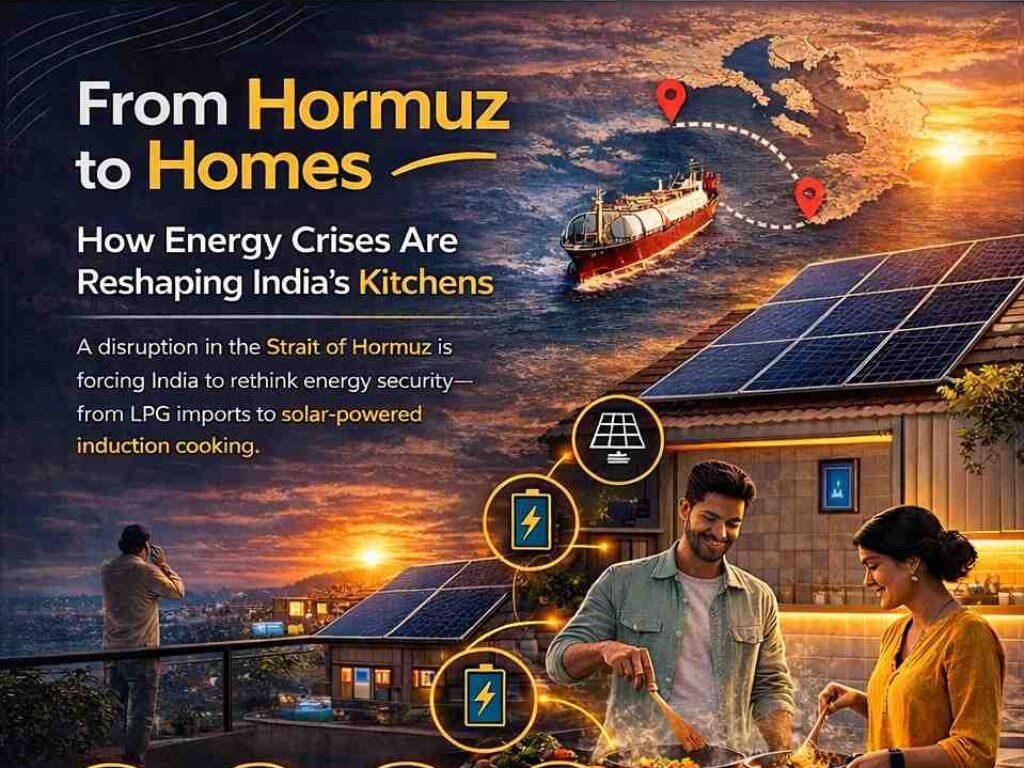
The Strait of Hormuz, disrupted due to the war in the Middle East, has led the stakeholders to think about supply and import bottlenecks of the liquified petroleum gas (LPG) and liquified natural gas (LNG) for cooking. The markets are rethinking.
The United Nations Conference on Trade and Development (UNCTAD) states that the Strait of Hormuz is among the world’s crucial maritime chokepoints, transporting almost a quarter of global seaborne oil trade and major volumes of liquefied natural gas and fertilisers.
It also brings to fore India’s energy position geo-politically, for a natural resource which does not come under “commons” is leading to a bottleneck. Soumya P. Garnaik, Country Representative – India, Global Green Growth Institute said , “The shift to induction stoves can significantly strengthen India’s geopolitical energy position considering India’s current imports of about 60% of its LPG needs, with nearly 90% of these imports coming from West Asia.
Garnaik added, “A large-scale move to induction cooking in a programmatic model in Indian households could save around 20 million metric tonnes of LPG per year, however resulting additional electricity demand & shifting focus from imported fuel to domestic power infrastructure as well as appliance supply-chain.With improved grid resilience and power availability, the shift to induction cooking would reduce exposure to international oil shocks and improves strategic autonomy as India’s energy security would become more domestically anchored.”
India’s commitment to fostering solar energy reflected in its goals and solar based schemes unfold an opportunity for solar-energy based cooking solutions. In the wake of the crises, it presents a business opportunity, too. Under PM Suryagarh Muft Bijli Yojna, over 3.1 million households have been solarised.
The Pradhan Mantri Suryagra Muft Bijli Yojana seeks to give rural people free solar electricity, which can have a big impact on the switch to cooking. Households may purchase solar cookers or other electric cooking appliances when free solar electricity becomes available, encouraging a change to greener, healthier cooking methods. All things considered, the project may encourage a more widespread shift in cooking toward sustainable energy options, said Prof Anjal Prakash, Research Director, Bharti Institute of Public Policy, Indian School of Business.
The solarisation, combined with the immediate crisis caused by the closure of the Strait of Hormuz, presents an opportunity for pushing a shift to solar based clean and safe cooking. Prakash continues, cost savings, health advantages, and environmental sustainability are highlighted in the solar cooking business case. Solar cookers contribute to the preservation of natural resources and the reduction of deforestation by eliminating the need for traditional fuels like wood and charcoal.
He added, they offer long-term financial advantages by eliminating gasoline costs. Additionally, solar cooking improves public health by reducing indoor air pollution, which is linked to respiratory ailments. Using solar cookers also contributes to energy security and climate change mitigation.
There is an option of utilising solar energy for cooking, wherein the solar energy is first converted into electricity by using PV panels and then the electricity generated is used for cooking by induction stoves. The upper middle class is catering to this option, however, the prices of induction are also rising. The transition to induction stoves strengthens India’s geopolitical resilience by signalling a move away from imported fuels and toward domestically controlled energy.
Electrification reduces exposure to global price shocks and supply interruptions, much like enterprises using biomass to lessen their reliance on LNG. However, actual security is dependent on power sources; induction cooking becomes a strategic advantage if electricity is produced locally, particularly through renewable means. In the end, it supports the larger shift to locally anchored, stable, and self-sufficient energy systems, stresses Amit Badlani, Managing Director, Vihaan Clean & Green Tech.
Badlani’s point also brings in the most important challenge with solar PV plus induction cooking, that is non availability of solar energy after sunset. The obvious solution to this is the use of batteries.
The difficulties with direct heating-based cooking are addressed by this choice. In this instance, cooking may be done indoors, at any time of day during sunny hours, and most importantly it can be scaled up or down.
Experts point out that, with a steep fall in battery prices and support for battery energy and storage systems, in future we may see the combination of solar rooftop, induction stove, and battery ruling our kitchens in place of the LPG cylinders.
However, there is a contrary reality that exists in terms of scale. Badlani said although the BESS ecosystem in India is still growing, the large-scale solar cooking project cannot yet be supported by it. Though there are still major obstacles, such as high costs and few decentralised installations, policy push and pilot projects have started to show encouraging signs of momentum.
For solar cooking to be viable as a reliable, sustainable, and locally secure energy source, BESS must also expand swiftly, be inexpensive during this period, and coexist with conventional renewable sources like biomass, Badlani added.
Rooftop solarisation success for now can be used for daytime, meanwhile with the growing adoption of BESS, 24×7 adoption of solar based cooking can be the strait of reality in future.