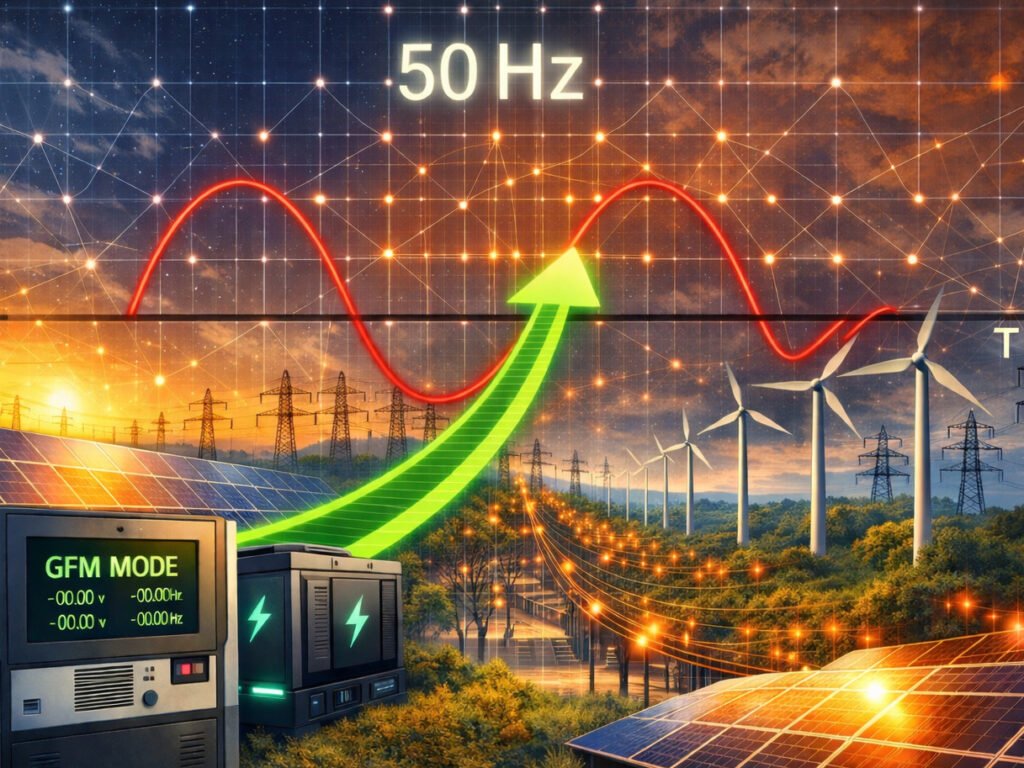
With the integration of solar and wind for the decarbonisation of electricity infrastructure, the question is not only achieving targets of generation but also managing the grid due to the variable and uncertain nature of solar and wind, and to ensure maximum utilisation of these environment friendly sources.
Inverters are the bridge for integrating renewable energy with the grid by converting the direct current (DC) into alternate current (AC). But their role is set to change from following the grid to leading the grid.
Recently, Grid-India, in a discussion paper titled, “Grid-Forming Technology and Possible Applications in the Indian Power System,” has proposed moving from grid following inverter (GFL) to grid forming inverter (GFM).
With the increase in the renewable sources of power forming the grid, the grid is also set to change its mechanism of being managed. To make the grid stable, experts point that grid-forming inverters is the way forward- which means inverters lead the way and not the grid leading the inverter.
This is needed since, grid leading the inverter in a scenario when renewable is on the rise will lead to stability challenges and limiting the integration and scaling of renewable energy.
While renewables like solar are based on DC and the grid is based on AC, the rhythm of the grid is maintained by the inverter by converting DC to AC by sensing the frequency and voltage in conventional inverters, so that the grid virtually works as a single machine. This was the old conventional method called grid following inverter and has its own challenges.
According to Rajesh Kaushal, Business Group Head of Energy Infrastructure & Industrial Solutions (EIS), India & SAARC, Delta Electronics India, as the nation moves closer to its 500 GW non-fossil capacity target, huge renewable clusters are becoming more connected to rural and poor grid areas. This has shown a structural issue as the grid was designed for large rotating machines working as generators and not the static inverters as generators.
He goes on: traditional grid-following inverters rely on an already stable grid and are unable to support the system during disturbances, which often results in large-scale tripping events. Between 2022 and 2025 alone, there were over 68 instances of large amounts of power (more than 1000 MW) tripping offline due to the current infrastructure’s inability to handle abrupt disruptions.
However, as the energy mix changes, led by green ambitions and advancement in battery energy storage systems (BESS), and as countries like Germany, Australia and Europe set the tone, a new approach is finding ground. GFM, which does not rely on outside reference points but makes its own reference points.
These inverters resemble more like conventional rotating generators in function and hence they are more supportive to the grid. This is a useful feature in managing large amounts of variable and uncertain energy sources like solar and wind. The distribution can be uneven due to variation in weather conditions like change in sunlight and wind flow change, GFM can set its frequency and lead to seamless energy transmission.
GFM technology allows the secure integration of higher renewable capacity yet maintains reliability by electronically strengthening the grid. It enables utilities and regulators to transition from grid limitations and renewable curtailment to secure, scalable decarbonisation, Kaushal continues.
The demand for GFM inverters is poised to grow in the Indian market. Government support for BESS will accelerate the demand for GFM. The recent publication from Grid-India is supposed to be a major initiative in this direction.
Mohammad Rihan, Director General, National Institute of Solar Energy, says, “The promotion of grid-forming inverters in the Indian power grid represents a critical enabler for the next phase of solar growth, allowing higher renewable penetration while strengthening grid stability, reducing curtailment, and supporting India’s evolving solar rich power grid.”
GFM inverters, which actively set and stabilise voltage and frequency, provide synthetic inertia, and strengthen the grid, enable BESS to function like a traditional power plant. GFM-enabled BESS becomes crucial infrastructure as inverter-based renewable energy sources take over power systems, enabling grids to run securely with very high solar and wind shares, according to Saurabh Kumar, Vice President of the Global Energy Alliance for People and Planet in India
GFM, BESS and recovery from blackout
Another important advantage of GFM inverters in combination with BESS is their black start capability. It means bringing the system back to normal condition after a large-scale electricity failure known as blackout. In order to accomplish this, grid-forming (GFM) and BESS first establish a stable “grid island” by adjusting voltage and frequency, energising local lines, and enabling vital infrastructure, including hospitals, water systems, and emergency services, to be powered up before the main grid is reestablished. The larger grid may be subsequently gradually and carefully rebuilt from these islands. As the likelihood of extensive outages increases due to climate-driven extreme weather events, this capability is becoming more and more crucial, according to Kumar.
GFM inverters are particularly useful for utility-scale solar plants, commercial and industrial installations, and huge BESS systems. It can help India safely integrate higher levels of renewable energy and move closer to its long-term clean energy goals by supporting grid stability, enabling black-start capability, and strengthening weak networks, says Samrath S. Kochar, CEO and founder of Trontek Electronics.
However, according to a paper by, “Grid-Forming Inverter-Based Resource Research landscape” published by IEEE, the “functionality” of GFM inverters depends on the source of energy used. Commercially run, GFM inverters usually use battery energy storage system based inverters. However, there is ongoing research to utilise non BESS sources like PV panels, type 3 and 4 wind turbines etc to be used in GFM inverters.
The paper notes, the advantage of this being using non- BESS sources lies in the capability in utilising present renewables and reducing the enormous costs related to energy storage systems. Another direction of research is working on the algorithms and software controls of inverters in realising GFM features without additional major BESS.
Way forward
Despite the potential role of these inverters in managing renewable rich grids there are certain challenges also. These inverters, for example, require fast responding energy sources like BESS to manage changes in demand or supply, increasing cost and complicating planning.
GFM inverters, moreover, behave differently from conventional synchronous machines around which the protection and control systems of the grid have been designed and operated.
Being an evolving area, interoperability of these inverters and their governing codes are yet to mature. The increased cost, lack of experience of grid operators and interplay of a large number of GFM among themselves are some of the other areas which require more exploration.