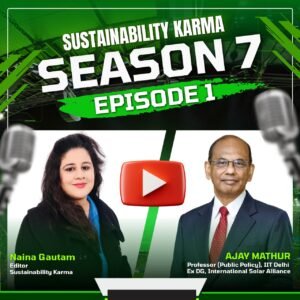
- What are your key observations on this year’s World Environment Day?
As you and many of our colleagues would probably know that the theme for this year’s World Environment Day 2025 is to end plastic pollution or ending plastic pollution.
And, of course, this is in continuation of a number of years of efforts, not just by UNEP but also by a number of agencies, including governments, in terms of how do we reduce plastic, plastic waste, plastic pollution.
And in fact in 2019, the theme for the year for the Environment Day was Beat Plastic Pollution. So, we to an extent have, you know, moved or graduated from beating plastic pollution to ending plastic pollution. And, of course, the kind of awareness of a common man, not just in India but also globally on the problem associated with plastics has phenomenally increased over the last number of years.
- What are the most promising innovations or solutions have you seen in plastic waste management recently?
A number. You know, in a country like India, what really surprises somebody who is looking from outside India, many times we don’t recognise it if you are in India, is the diversity of the creativity and innovation that happens. That has been phenomenal.
The kind of interventions that are happening are really, really big in terms of not only diversity, but also the stakeholders who are involved in coming up with these kinds of innovations.
But the challenge at the same time, not just in India, but globally also is that creativity has to be supported by investments so that the innovations can actually have an impact when it comes to markets, when it comes to consumer choices, when it comes to changing consumer behaviours and patterns and things like that.
- How do you assess the private sector’s evolving role in addressing plastic waste management?
Significant because to an extent, as you know, the private sector plays a very, very important role both in finding solutions and also reducing the challenges.
So, the industry to an extent in India has been quite forward-looking, and it’s a very encouraging trend. And several of them are coming into it together. What we are now intending to do are two things.
One, how can they handhold those who actually will not be able to make those investments, but are very important stakeholders in making plastic pollution a history. But at the same time, what is that they can do, to actually look at reducing the costs of a number of these interventions so that the applicability or the adoption of these becomes much better for the common man.
- If I were to ask you to just highlight three things about plastics pollution, what would those be?
The first thing is, the way we have gotten addicted to plastics, is the need to definitely de-addict. We need to detoxify.
The second element of it is that small but incremental changes to our lifestyles are something which can be easily done. That is something which every individual can do. You know, you not buying a plastic water bottle, or you refusing to take water from a plastic water bottle, in itself will contribute.
So what is important for us is to actually look at is what are the small changes that we can do because collectively it will actually have a huge impact. And, lastly and importantly, this entire thing has to be driven as a citizen’s movement.
In as much as the industry will have a role to play, the choices of the citizens will also determine what the industry can do or will do. And that is where we need to have the behavioural change.